
Continuous Learning for Real Intelligence
Not all learning is created equal

Human power and dominance stems from our adaptability, not from our strength. This adaptive learning advantage is greatly enhanced by our unique language ability. We became the ‘rational animal’ by utilizing language to compactly transmit and acquire knowledge, and to be able to think more effectively — including our metacognitive ability to think about thinking.
What does that imply for practical general purpose AI and AGI?
Personal assistants, AI workers, and domestic robots need to function effectively in the real world which is dynamic, messy, and noisy. They must be able to quickly adapt to novel circumstances given limited time and data. They will not be able 'keep trying till they get it right’ or go back to the factory for additional bulk training. Specifically, they also need to be able to reliably adjust their knowledge and behavior based on natural language input.
For example, you just got married and moved to a new home. Or you just had your first child. Lots of things change in your life. There are the generalities that your AI should already know, but there are also many specifics and their implications. To be effective, your personal assistant AI needs to ask for details and clarification proactively, just as a good human helper would. It must fully integrate and generalize this new information with existing knowledge so that ongoing interactions fully take this new context into account.
Or take a domestic robot: Renovations to the house; a new pet or guest with special requirements; or precariously stacked dishes in a cupboard: “Be careful when you open that door”. Or showing your robot how to get to that hidden shut-off valve under the sink: “You’ll have to kneel down and feel for it with your left hand”. The long-tail of novel situations is endless.
The same applies to commercial applications like customer support, accounting, administration, research, sales, whatever. Things change: Products and services, business practices and rules, regulations, fads come and go, emergency situations arise, the list is endless. Real-time, autonomous adaption is an ongoing requirement.
Even for self-driving cars real-time learning would get us that ‘last mile’ of competence: Learning where those invisible potholes are, staying far away from that nasty hidden driveway, or even adapting dynamically to driving on the other side of the road, simply being told about the change: “We’ve just arrived in England, now you need to drive on the left!”
To note, any AGI with human-level vision and basic dexterity could easily learn to drive any car, making dedicated self-driving technology obsolete!
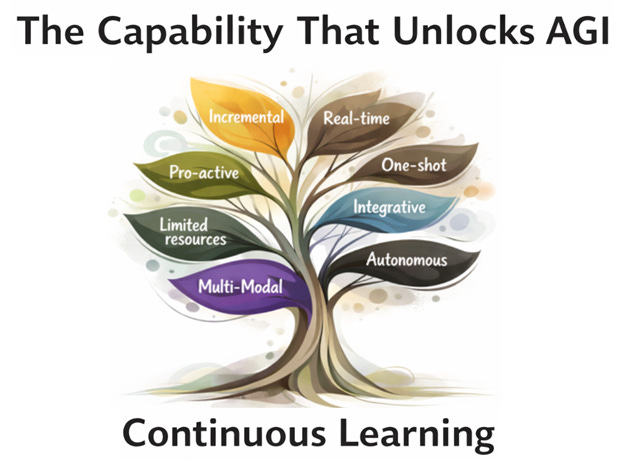
To summarize, this kind of life-long learning has several essential characteristics:
Incremental — Absorbing information one piece at a time
Real-time — Learning while busy with everyday activities
One-shot — The ability to ‘update the model’ with single examples
Pro-active — Knowing when to ask for clarification or missing details
Integrative — Automatically updating and generalizing implications
Multi-Modal — Learns via perception-action as well as natural language
Limited resources — Learning with incomplete, noisy data in real-time
Autonomous — The AI needs metacognitive control to know what it knows and what it doesn’t know, and to proactively manage the learning process
These are hard requirements for AGI.
GenAI-based systems simply cannot meet these requirements. Impossible. Input buffers or RAG cannot change core model weights, and the model itself cannot be updated without bulk (gradient descent) training.
An approach that fully meets all of the requirements (and then some) is Cognitive AI, or what DARPA calls ‘The Third Wave of AI’. Cognitive AI is based on a first principles approach to understanding what makes human intelligence so powerful. For now, it is the road less travelled. The relative success of GenAI and LLMs has ‘sucked all of the oxygen out of the air’ for alternative approaches.
The tide will soon turn towards Cognitive AI as more people begin to understand the true need and meaning of ‘continuous learning’, and its tremendous benefits.
Inherent advantages of real-time, incremental learning include:
A million times less training data — Can acquire adult-level language and reasoning ability with only millions of training words instead of trillions
Massively less compute required — Training and operation can be done on a single off-the-shelf computer
Commercial accuracy, reliability, cost-effectiveness — Self-directed learning eliminates the cost of data collection, batch training, guard-rail development and ongoing maintenance while providing transparent trustworthy dependable service
Truth-seeking — Proactive integration under metacognitive control provides for robust validation and accuracy, and prevents hallucination
Positive human values — Because far less data is needed, the emphasis can shift from sheer volume to the quality of the training curriculum, helping the AI develop a robust sense of what actually serves human flourishing
Privacy, security, and ownership — The ability to operate on the edge, on a single computer, allows for systems that are truly owned and controlled by the individual to serve their purpose, and not some extractive mega-corporation’s
We’re accelerating Cognitive AI to deliver fully autonomous, adaptive agents that boost human agency and flourishing.
Very insightful! I work at an investment bank and since this is a highly regulated industry, I am cautiously optimistic about how AI will be used in my industry.
I am concerned about the potential impact on the individual’s creativity, imagination, critical thinking and analytical thinking.
Most comprehensive, thorough and insightful understanding of "Continuous Learning", a capability that unlocks real intelligence. Thanks for sharing.