
All you need for Intelligence is... What?
Not attention or scaling or RAG or whatever, but Theory.

The ultimate goal of AI has always been to build machines that can think, learn, and reason like us (and better) — to adapt to changing circumstances in real time-time, and to be able to solve novel problems (more).
Early language applications such as Google Translate didn’t aspire to such lofty goals, but as they scaled from million to billion, and eventually to trillions of training words something changed. At first it seemed that scaling was the answer. But it wasn’t enough. For one, they ran out of data, and in any case it didn’t overcome the inherent limitations of these large (huge!) language models.
Transformers revolutionized LLMs via predictive attention. But we needed more…
More scaling and Reinforcement Learning from Human Feedback (RLHF). Nope…
Custom fine-tuning. No. Prompt engineering. What a pain...
More scaling and Retrieval-Augmented Generation (RAG). No cigar.
Training with Chain of Thought (CoT). Still hallucinating…
Million-token context windows and scaling. Nyet.
Scaling via Mixture of Agents (MoA). A million monkeys can’t produce Hamlet.
Agentic AI (Google Dialog Flow on steroids). Nope, that didn’t quite do it either.
Maybe if we standardize interfaces with Model Context Protocol (MCP)? :(
Now throw some serious compute at the problem with Reinforcement Learning and you end up with what? Expensive hyper-optimized Narrow AI (more).
Ah! We need to scale via world models and more RL (and what a nice revenue source for Nvidia). Another trillion or two should do it — somehow…
No, this is not the road to Real Intelligence
Yes, each of these tweaks have added some functionality — but limited, and at significant, uneconomical implementation and maintenance cost. However, they simply cannot address core limitations (more). Why aren’t these hacks getting us to robust, adaptive, general AI?

Because they are reactive fixes to limitation as they arise — not a fundamental, first principles reassessment as what intelligence requires. The current AI monoculture road-to-nowhere is stumbling blindly around design space instead of being guided by the North Star of understanding what makes human intelligence so special.
Unique aspects of our cognition have allowed us to create science and technology, and to dramatically improve the human condition. These abilities include:
To quickly adapt to changing circumstances given limited time and resources
To dynamically form contextual generalizations and high-level abstractions
To reason conceptually, using self-reflection (more)
The lack of principled design can be summarized as “The 7 Deadly Sins of AGI Design” (more)

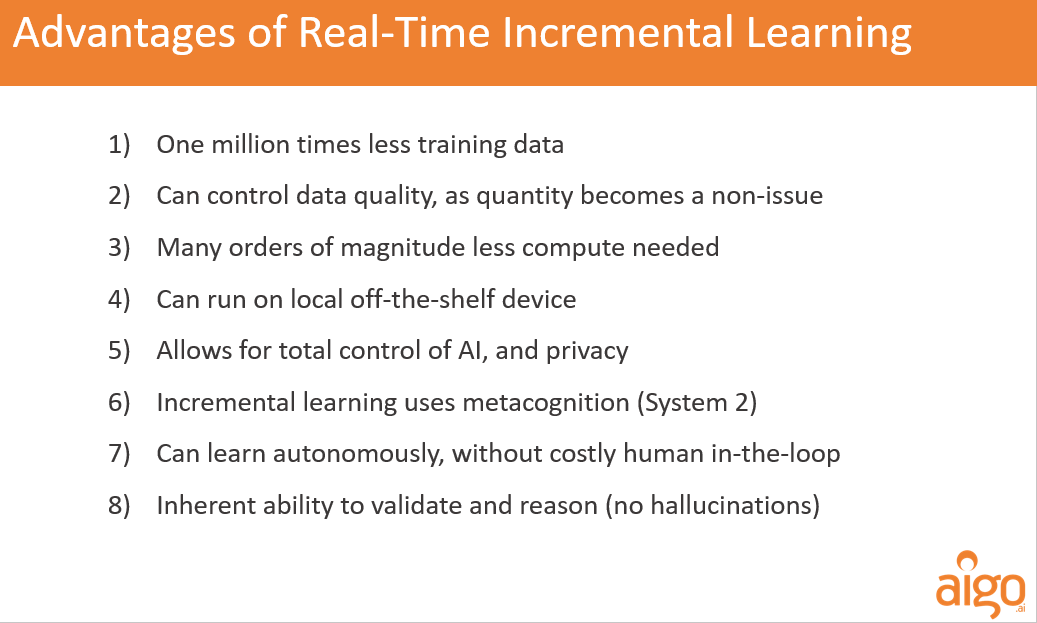
On the other hand, the benefits of a real-time, highly adaptive cognitive approach are substantial.
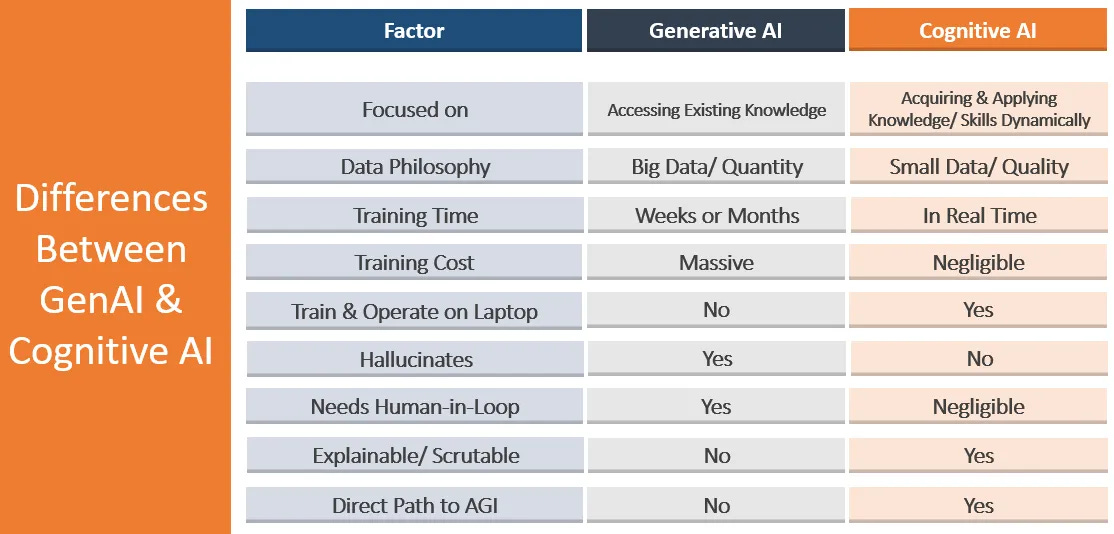
The Cognitive AI approach is nothing like the brute-force statistical process underlying Generative AI — it is much closer to human cognition where a child can learn language and reasoning with a few million words, not trillions, and do that with something like 20 watts, not 20 gigawatts. It couldn’t be more different. Like chalk and cheese.
Near-term commercial and academic reward systems are fueling the current Generative AI monoculture. Benchmaxing, cherrypicked promo stats, and shiny prototypes are continuing to demonstrate progress, but solid commercial value is scarce. These systems are still narrow; not adaptive or general (more).
Alternative approaches based on a more solid theoretical foundation such as Neuro-Symbolic cognitive architectures, will break us out of the current dead-end path, and speed us towards real intelligence (more).
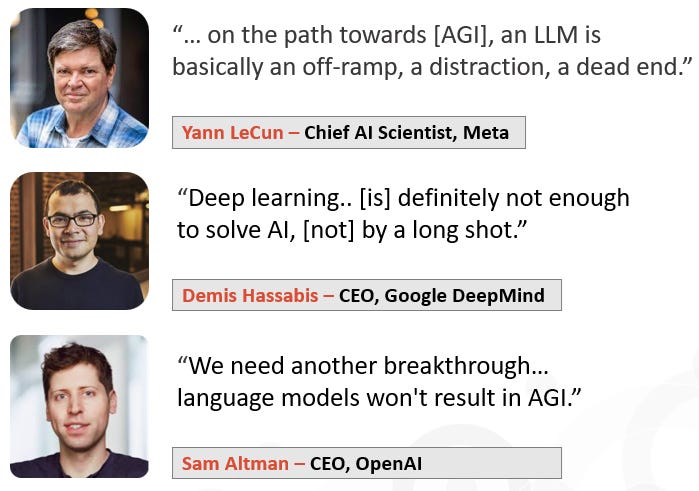
As you say, all the approaches are by advocates flailing around in desperation, trying all sorts of kludges that haven't and will never work. We can confidently say this based on the fundamentals of the transformer and diffusion model.
Strong diagnosis, especially the critique of scaling, RLHF, and agentic patchwork as reactive fixes rather than first-principles design. The monoculture point is well taken.
Where I’d push a little further is this: theory alone isn’t the escape hatch either.
Most cognitive / neuro-symbolic architectures fail not because they lack theory, but because they lack volitional discontinuity. They can reason, abstract, and reflect, but they cannot refuse. Without the ability to reject false premises, framing traps, or coercive objectives, cognition collapses under pressure into brittle optimization.
Human intelligence isn’t special because it reasons, it’s special because it can say “no, that assumption is wrong” and re-anchor.
So I’d frame the missing North Star slightly differently:
intelligence = coherence that survives recursion under constraint, not just theory-driven cognition.
Still, this is one of the clearest critiques of the scaling-first dead end I’ve seen. Glad to see someone calling it out cleanly.